


Home / Casino Comparisons / Progressive Jackpot vs Fixed Jackpot: The Guide to Smart Slot
Progressive Jackpot vs Fixed Jackpot Key Takeaways
Choosing between progressive jackpot vs fixed jackpot slots depends on your risk tolerance and playing style.
- Progressive jackpots pool bets across many players, creating massive prizes that reset after a win.
- Fixed jackpots pay a set amount every time you hit the winning combination, offering consistency and higher RTP rates.
- Smart players match their bankroll and play session goals to the right jackpot type — not all jackpots are created equal.
Table of Contents
- What Makes Progressive Jackpot vs Fixed Jackpot Different
- Why the Prize Pool Mechanics Matter
- How Progressive Jackpot Slots Work — The Life-Changing Potential
- Real-World Numbers: What the Odds Actually Look Like
- Fixed Jackpot Slots — Predictability and Consistent Returns
- Best Use Cases for Fixed Jackpot Play
- Player Psychology: Why We Choose One Over the Other
- Which Jackpot Type Offers Better Value
- Quick Comparison Table: Progressive vs Fixed Jackpot
- How to Choose the Right Jackpot Slot for Your Play Style
- Useful Resources
- What is the main difference between progressive jackpot and fixed jackpot slots ?
- Which pays more often: progressive or fixed jackpot slots ?
- Can you win a progressive jackpot with a minimum bet?
- Are progressive jackpot slots rigged?
- What is the typical RTP of a fixed jackpot slot?
- Do progressive jackpot slots have lower RTP?
- How do you win a progressive jackpot?
- Can you play progressive jackpot slots online?
- What is a standalone progressive jackpot?
- Are fixed jackpot slots better for beginners?
- What is the biggest progressive jackpot ever won?
- Should I always bet max on progressive slots?
- Do fixed jackpot slots have bonus rounds?
- Which type of jackpot slot has better odds?
- Can progressive jackpots be won by multiple players?
- Are there strategies to increase my chances on progressive slots?
- What is a seed amount in progressive jackpots?
- Do all progressive slots require a maximum bet for the jackpot?
- Can I play progressive jackpot slots for free?
- Is progressive jackpot vs fixed jackpot really about luck?
What Makes Progressive Jackpot vs Fixed Jackpot Different
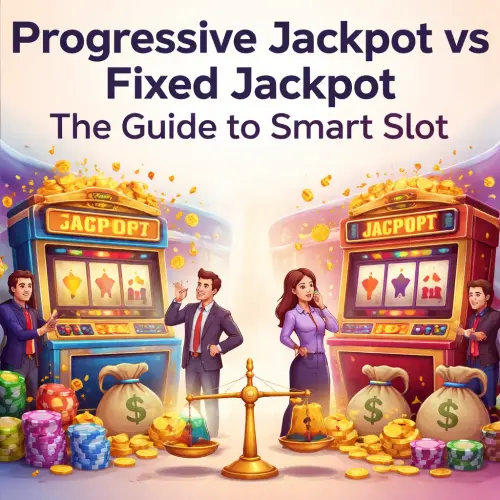
At their core, progressive jackpot slots and fixed jackpot slots determine their top prizes in fundamentally different ways. A fixed jackpot is exactly what it sounds like: a predetermined amount that does not change regardless of how many times the game is played or how many players spin the reels. If a machine offers a 10,000-coin jackpot, that number remains constant until someone hits the winning combination.
In contrast, progressive jackpots accumulate a portion of every wager placed across a network of machines (or even multiple casinos). That small percentage — typically between 1% and 5% of each bet — feeds a growing prize pool that can climb into the millions. This fundamental structural difference affects every aspect of the game: odds, volatility, and player psychology.
Why the Prize Pool Mechanics Matter
The way jackpots grow directly influences your chances of winning. Fixed jackpot games operate with known probabilities because the top prize never changes. You can calculate your expected return if you know the game’s paytable and hit frequency. Progressive jackpot slots, however, introduce an element of randomness that extends beyond the reel spins — the jackpot can be hit at any bet level, but the odds are usually far lower than what you’d see in a fixed prize game. For a related guide, see Progressive Jackpot Slots Explained: Mechanics, Odds, and Player Insights.
Statistically, a fixed jackpot slot might have a hit frequency of 1 in 50,000 spins for its top prize. A wide-area progressive can exceed 1 in 50 million spins. That trade-off is the heart of the progressive vs fixed jackpot decision.
How Progressive Jackpot Slots Work — The Life-Changing Potential
A progressive jackpot slot links multiple machines together, often across an entire casino network or even state and international lines. Each time a player spins, a small portion of their bet goes into the shared jackpot meter. This meter climbs relentlessly until one lucky spin triggers the top prize.
There are three common types of progressives:
- Standalone progressive: Limited to one machine, grows modestly, hit frequency is highest among progressives.
- Local area progressive: Connects machines within a single casino or small group of properties, offering mid-range prizes.
- Wide-area progressive: Links machines across multiple casinos, states, or even countries. These are the record-breakers, often exceeding $10 million.
The allure is obvious — a single spin can turn a modest bet into a seven-figure windfall. But the trade-off is steep. Most progressive games have a lower base-game Return to Player (RTP) percentage, often between 85% and 90%, compared to 95%–98% for fixed jackpot slots. The difference comes from the portion of each bet diverted to the jackpot pool. For a related guide, see Infiniwinmy vs Royalewin – Which Online Casino Is Better in Malaysia (2026 Comparison).
Real-World Numbers: What the Odds Actually Look Like
A study of major wide-area progressives found that the odds of hitting the top jackpot can be as low as 1 in 50 million spins. If you spin once every three seconds, that translates to playing 24 hours a day for over four years to reach statistical parity. In contrast, a fixed jackpot slot like a classic 3-reel fruit machine might offer a top prize hit rate of 1 in 50,000 spins.
Yet players still chase progressives because of the sheer size of the prize. When a wide-area progressive like Megabucks hit for $39.7 million in Las Vegas in 2003, that single payout changed the entire conversation around slot play. The emotional appeal — not the math — drives most progressive play.
Fixed Jackpot Slots — Predictability and Consistent Returns
Fixed jackpot slots offer a completely different experience. The top prize is printed right on the machine or displayed in the paytable, and it stays there regardless of how many people play. If the jackpot is 5,000 coins, it will always be 5,000 coins. This predictability allows players to calculate their expected losses and potential wins with far greater accuracy.
Because no portion of each bet is siphoned into a progressive pool, fixed jackpot games can afford to return more to players on a per-spin basis. A typical fixed jackpot slot has an RTP of 95% to 98%, meaning the house edge is only 2% to 5%. For a player who values bankroll longevity, that difference is enormous.
Best Use Cases for Fixed Jackpot Play
Fixed jackpot games are ideal for:
- Players with smaller bankrolls who want session time.
- Tournament or bonus hunters who need predictable volatility.
- Anyone who prefers known probabilities over lottery-like odds.
- Practicing bankroll management strategies like the Martingale or flat betting.
For many regular players, the psychological comfort of a fixed top prize outweighs the fantasy of hitting a life-changing progressive. You know exactly what you’re playing for, and you can plan your session around it.
Player Psychology: Why We Choose One Over the Other
The progressive jackpot vs fixed jackpot debate is as much about psychology as it is about math. Progressive jackpots tap into the same emotional triggers as lotteries: the dream of a massive, life-altering win. The ticking meter, the flashing lights, the ‘must drop soon’ messages all create urgency and excitement that fixed games cannot replicate.
But that excitement comes at a cost. Studies show that players spend longer at progressive machines and bet more per spin, drawn in by the growing prize. The house edge is higher, and the hit frequency is lower. For casual players, this can lead to faster bankroll depletion and greater frustration.
Fixed jackpot players, by contrast, tend to report higher satisfaction with their sessions because they experience more frequent small wins and a more predictable pace. The trade-off is that they will never win a million-dollar prize from a single spin. Understanding your own personality and goals is the key to making the right choice.
Which Jackpot Type Offers Better Value
From a pure value perspective, fixed jackpot slots almost always win. Their higher RTP means you lose less money over time. For example, a 96% RTP fixed slot will lose only $4 for every $100 wagered on average, while an 88% RTP progressive will lose $12. Over 1,000 spins at $1 each, that difference is $80 in lost value.
However, value is not just about the base game. If you hit a progressive jackpot, the payout can dwarf any loss calculation. The expected value of a progressive becomes positive only when the jackpot grows high enough to offset the lower base RTP. Mathematically inclined players track jackpot sizes and only play when the prize exceeds a certain threshold — typically when the jackpot is 2 to 3 times its seed amount.
Quick Comparison Table: Progressive vs Fixed Jackpot
| Factor | Progressive Jackpot Slots | Fixed Jackpot Slots |
|---|---|---|
| Top Prize | Can reach millions, growing over time | Set amount, typically 1,000–100,000 coins |
| Base Game RTP | 85%–90% | 95%–98% |
| Hit Frequency | Very low (1 in millions) | Moderate (1 in thousands) |
| Volatility | Extremely high | Low to medium |
| Psychological Appeal | Life-changing dream, excitement | Predictability, steady play |
| Best For | High-risk tolerance, lottery fans | Bankroll management, casual play |
How to Choose the Right Jackpot Slot for Your Play Style
Making the correct choice between progressive jackpot slots and fixed jackpot games starts with honest self-assessment. Ask yourself three questions:
- What is my session budget? If you have $50 to play for two hours, a fixed game will give you far more entertainment.
- Why am I playing? If the goal is excitement and the chance at a huge win, progressive is the way. If you want consistent returns and longer play, stick with fixed.
- Can I handle the volatility? Progressives can drain a bankroll in minutes. Fixed games offer gentler swings.
Some players adopt a hybrid approach: spend 90% of their bankroll on fixed jackpot games for steady returns and invest 10% in progressives for a shot at the big prize. This balanced strategy gives you the best of both worlds without overexposing your funds.
Useful Resources
For more detailed information about slot machine mathematics and RTP, refer to these authoritative sources:
Frequently Asked Questions About Progressive Jackpot vs Fixed Jackpot
What is the main difference between progressive jackpot and fixed jackpot slots ?
The main difference is that progressive jackpots grow with each bet placed across linked machines, while fixed jackpots remain at a set amount regardless of play volume.
Which pays more often: progressive or fixed jackpot slots ?
Fixed jackpot slots pay the top prize far more often — typically once per 50,000 spins, compared to once per 50 million spins for wide-area progressives.
Can you win a progressive jackpot with a minimum bet?
Yes, most progressive slots allow you to win the full jackpot with the minimum bet, though some require the maximum bet for the top prize — always check the paytable.
Are progressive jackpot slots rigged?
No, regulated progressive slots use certified random number generators and are audited by gaming authorities. The low hit frequency is a mathematical reality, not manipulation.
What is the typical RTP of a fixed jackpot slot?
Fixed jackpot slots usually have an RTP between 95% and 98%, making them more favorable for the player compared to progressives.
Do progressive jackpot slots have lower RTP?
Yes, progressive jackpot slots typically have an RTP of 85% to 90% because a portion of each bet goes into the growing jackpot pool.
How do you win a progressive jackpot?
You win by landing a specific combination of symbols — usually the rarest one in the game — or by triggering a bonus round that awards the jackpot.
Can you play progressive jackpot slots online?
Yes, most online casinos offer progressive jackpot slots with the same mechanics as land-based machines, including wide-area networks.
What is a standalone progressive jackpot?
A standalone progressive is limited to a single machine, grows from bets placed only on that machine, and has better odds than wide-area progressives.
Are fixed jackpot slots better for beginners?
Yes, fixed jackpot slots are better for beginners because they offer predictable play, lower volatility, and longer session time for the same bankroll.
What is the biggest progressive jackpot ever won?
The largest recorded progressive jackpot was $39.7 million on Megabucks at the Excalibur in Las Vegas in 2003.
Should I always bet max on progressive slots?
Only bet max if the game requires it for the top jackpot; otherwise, betting minimum preserves your bankroll and still qualifies for the prize.
Do fixed jackpot slots have bonus rounds?
Yes, many fixed jackpot slots include bonus rounds, free spins, and multipliers, just like progressive games.
Which type of jackpot slot has better odds?
Fixed jackpot slots have better odds for the top prize because the hit frequency is higher and the RTP is more favorable.
Can progressive jackpots be won by multiple players?
No, only one player wins the progressive jackpot per win; the meter then resets to its seed amount and starts growing again.
Are there strategies to increase my chances on progressive slots?
No strategy changes the odds — they are random. The only strategic move is to play when the jackpot is high relative to its seed value.
What is a seed amount in progressive jackpots?
The seed amount is the minimum starting jackpot after a win, usually funded by the casino. It can range from $1,000 to $10 million.
Do all progressive slots require a maximum bet for the jackpot?
No, but some older machines and certain brand-name games do. Always read the rules or paytable before playing.
Can I play progressive jackpot slots for free?
Many online casinos offer demo versions of progressive slots, but you cannot win real money in free play mode.
Is progressive jackpot vs fixed jackpot really about luck?
Both types rely entirely on luck — no skill can influence the outcome. The choice is purely about which kind of luck you prefer: rare and massive, or more frequent and predictable.